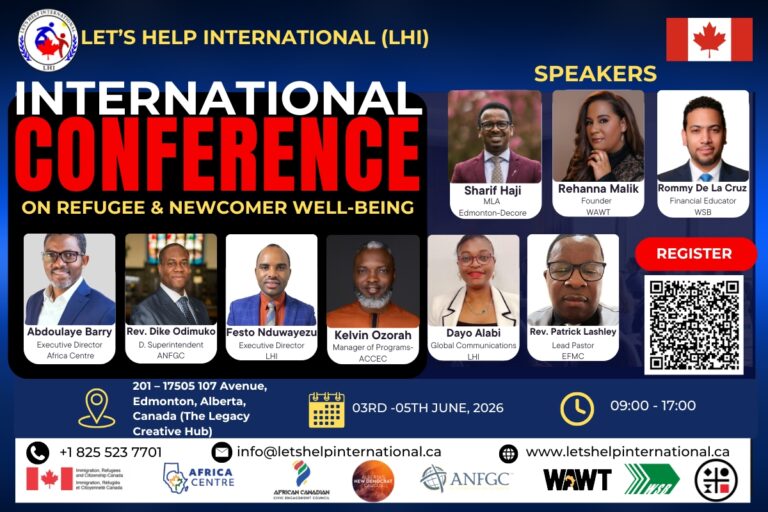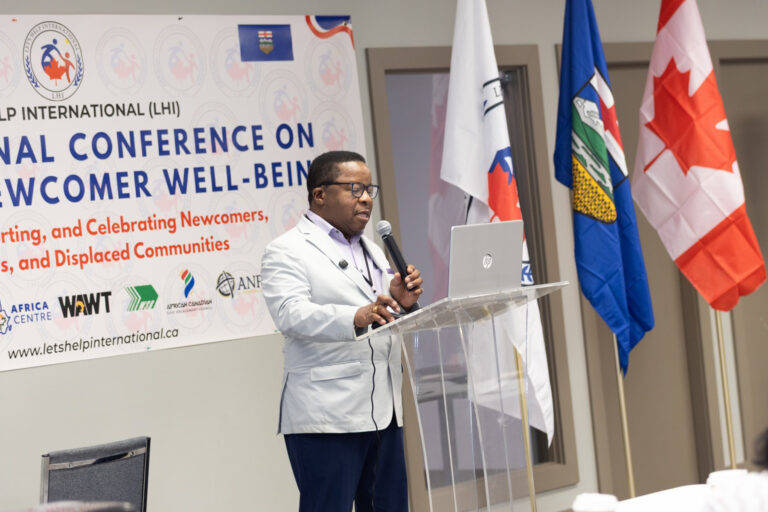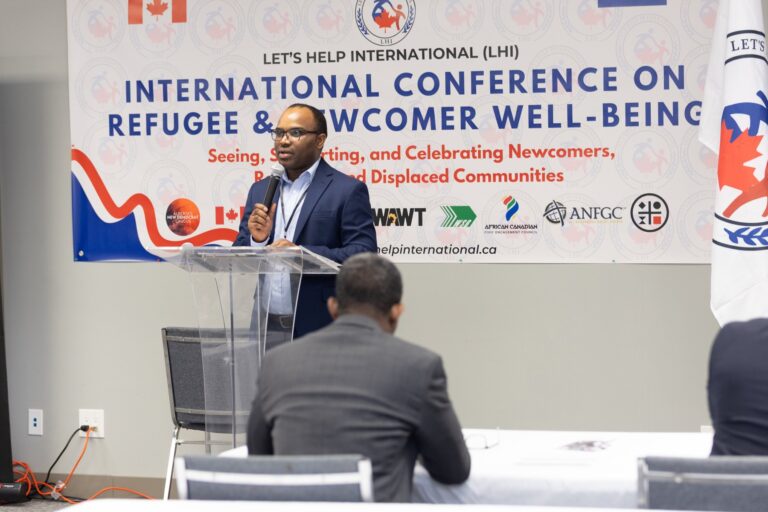
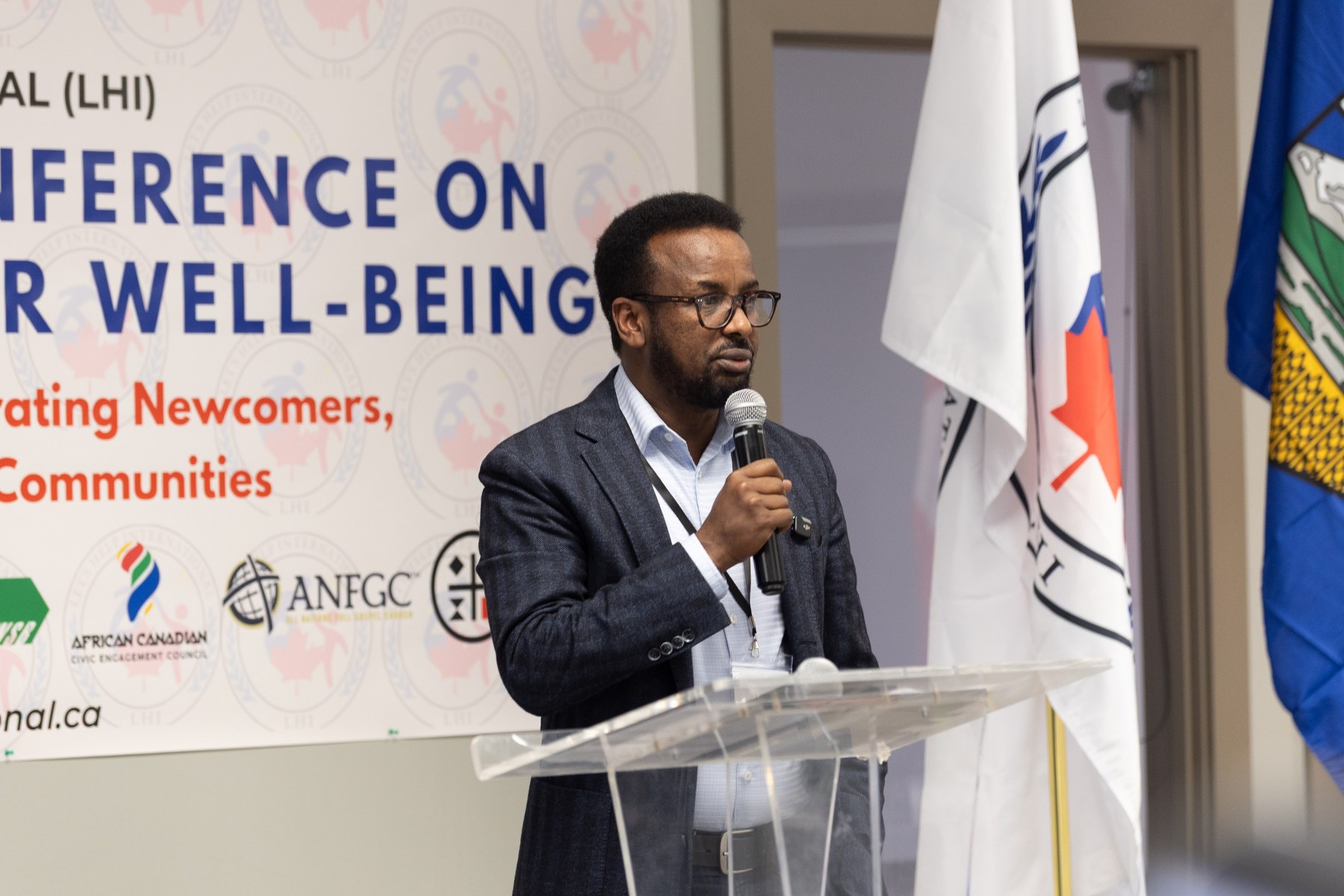
At the Let’s Help International (LHI) International Conference on Refugee & Newcomer Well-Being 2026, delegates heard a powerful and deeply personal address from Sharif Haji, who spoke on the conference theme “Building Inclusive Communities: Practical Tools for Supporting Newcomers.”
Drawing from his own journey as a refugee, community leader, former Executive Director of the Africa Centre, and now a Member of the Legislative Assembly representing Edmonton-Decore, Haji challenged participants to rethink how communities support refugees and newcomers—not through pity or deficit-based thinking, but by recognizing their resilience, strengths, and potential to contribute.
The conference brought together community leaders, policymakers, service providers, faith organizations, researchers, and newcomers to discuss practical solutions for strengthening refugee and newcomer well-being.
Refugees Are Everyone’s Concern
Haji began by asking participants how many had a refugee background or knew someone who did. Nearly every hand was raised.
His point was clear: refugee experiences affect entire communities.
He reminded the audience that displacement can happen anywhere, often without warning.
Using Syria as an example, he recalled how the country went from hosting one of the world’s largest refugee populations to producing one of the world’s largest refugee crises within just four years.
“It can happen in any part of the world,” he said. “People are impacted by circumstances they neither created nor could stop.”
Because of this reality, Haji emphasized that societies have a moral obligation to welcome and support those forced to flee conflict and persecution.
Challenging Misconceptions About Refugees
Reflecting on Canada’s decision in 2015 to welcome 25,000 Syrian refugees, Haji recalled the fears and misinformation that surrounded their arrival.
Many questioned whether refugees would pose security risks.
Years later, he noted, those fears proved unfounded.
Instead of becoming a burden, newcomers have contributed to Canada’s economy, communities, and social fabric.
“We have to stop thinking about what newcomers might take,” he said. “We need to think about what they bring.”
Seeing Strength Instead of Deficit
A central message throughout his presentation was the importance of shifting perspectives.
Too often, conversations about refugees focus on language barriers, employment challenges, or financial struggles.
While those challenges are real, Haji argued that they should not define newcomers.
Instead, communities should recognize the extraordinary resilience refugees develop through surviving displacement, rebuilding their lives, and adapting to entirely new environments.
“People are not arriving only with needs,” he explained. “They are arriving with strengths.”
Understanding both their resilience and their vulnerabilities allows communities to provide support that is both compassionate and empowering.
The Hidden Loss: Social Capital
One of the most powerful parts of Haji’s speech focused on what refugees lose when they flee.
While financial hardship often receives the most attention, he argued that the greatest loss is social capital.
“When you leave your country,” he explained, “you leave behind your friends, professional networks, reputation, and the relationships that helped you succeed.”
He shared his own experience arriving in Canada.
Although he needed employment and education, what he wanted most was to build relationships.
He intentionally sought places where people gathered, eventually connecting with the Africa Centre and applying as a volunteer.
Initially, he was rejected because his professional references came from Africa and could not easily be verified.
Years later, however, he returned to the same organization—not as a volunteer, but as its Executive Director.
His journey illustrated how opportunities, persistence, and community connections can transform lives.
Welcoming Environments Create Success
Haji stressed that inclusive communities do not happen by accident.
They require intentional investments in welcoming environments.
He described arriving in Canada and applying for graduate studies shortly after landing.
When his application was rejected, he did not simply accept the decision.
Instead, he contacted the university, requested feedback, addressed the concerns, and reapplied.
His story highlighted another important lesson:
Supportive institutions that provide guidance, transparency, and opportunities can help newcomers unlock their full potential.
Policies Matter
Beyond personal determination, Haji emphasized that public policies play a critical role in newcomer success.
He reflected on programs that once enabled newcomers to pursue education while receiving temporary financial support, helping them gain skills and transition into employment.
He also pointed to the importance of affordable housing, social infrastructure, and accessible community services that allow families to establish stable lives while building their futures.
Without these supports, newcomers face unnecessary barriers to achieving their potential.
Economic Inclusion Requires Access
Haji also addressed one of the less visible barriers newcomers encounter: access to capital.
Many immigrants arrive with strong professional backgrounds and entrepreneurial ambitions but struggle because Canadian financial systems often rely heavily on local credit histories.
He argued that character, community trust, and demonstrated responsibility should also play a role in evaluating entrepreneurs.
As one of the co-founders of the Federation of African Canadian Economics (FACE), he highlighted efforts to improve access to financing for immigrant entrepreneurs, helping them participate fully in Canada’s economy.
Belonging Is the Foundation of Inclusion
Perhaps the strongest message of the presentation centered on belonging.
According to Haji, inclusion cannot simply be declared—it must be experienced.
“It doesn’t matter what you tell me,” he explained. “I have to feel that I belong.”
He expressed concern about growing anti-immigration rhetoric and political polarization, warning that fear-based narratives undermine newcomers’ confidence, participation, and willingness to invest in their communities.
When people genuinely feel accepted, they are more likely to build businesses, raise families, volunteer, and contribute to society for generations.
Principles Matter More Than Tools
Although invited to speak about “practical tools,” Haji concluded that no universal toolkit exists.
Every newcomer’s journey is different.
Instead, he proposed a set of guiding principles that should shape every community’s approach:
- Treat every person with dignity.
- Uphold equality and fairness.
- Listen to individual experiences.
- Recognize newcomers as partners in solutions.
- Focus on strengths rather than deficits.
- Understand each person’s unique needs and circumstances.
- Foster opportunities for leadership and participation.
These principles, he argued, create stronger communities than any single program or policy alone.
A Shared Responsibility
Closing his address, Haji reflected on his Islamic faith, recalling the story of the Prophet Muhammad encouraging persecuted followers to seek refuge in the Kingdom of Aksum (Habesha), where the Christian King Najashi offered justice and protection regardless of faith.
The story, he explained, illustrates a timeless principle: societies flourish when they protect the vulnerable and uphold justice for all.
He connected that lesson to Canada’s Charter of Rights and Freedoms, reminding participants that preserving an inclusive and welcoming country is a shared responsibility.
“We all came here because Canada is a place where justice exists and people should not be marginalized,” he said. “We all have a responsibility to ensure it remains that way.”
Building Communities Where Everyone Belongs
Haji’s keynote reinforced one of the conference’s central messages: supporting newcomers is about more than providing services—it is about creating communities where people feel valued, connected, and empowered to contribute.
When governments, community organizations, faith leaders, employers, and residents work together to strengthen belonging, everyone benefits.
As Canada continues to welcome newcomers from around the world, Haji reminded participants that inclusion is not merely a policy objective—it is a shared commitment that shapes the future of stronger, more compassionate communities.